
How Much Does a Website Cost in Canada? (The Honest 2026 Answer)
You’ve asked three different agencies for a website quote and gotten back $800, $8,000, and $22,000. They’re all describing the same thing or are they? This guide cuts through the noise and gives you real Canadian pricing, what drives the difference, and exactly what questions to ask before you spend a dollar.
What you'll learn in this guide
- .Why website prices vary so wildly in Canada
- The 5 pricing tiers — and what you actually get
- The hidden costs most agencies won’t mention upfront
- DIY builders vs. a professional agency: the real comparison
- 7 questions to ask before hiring any web agency in Canada
- What does a website cost in Kitchener-Waterloo specifically?
- Stop thinking about cost — start thinking about return
Why Website Prices in Canada Vary So Much
Let’s address the elephant in the room first. If you’ve shopped around for web design or development in Canada in 2026, you’ve likely seen quotes ranging from a few hundred dollars to well over six figures. The confusion is real and it’s not because someone is lying to you.
The variation exists because the word “website” is doing an enormous amount of heavy lifting. A brochure site for a freelance photographer and a lead-generating platform for a B2B software company are both called “websites.” They share almost nothing else.
Here is what actually drives the price of a Canadian website build:
- Scope: How many pages? Are any of them built around unique logic (calculators, booking systems, membership portals)?
- Design approach: Custom-designed from scratch, or a premium template with your branding applied?
- Content: Is the agency writing your copy, sourcing photography, and producing video? That alone can add $2,000–$10,000+.
- Integrations: Does your site need to connect to a CRM, a payment gateway, an inventory system, or a booking tool?
- SEO strategy: Is the site being built to rank, or just to exist? This is the difference that matters most in year two and three.
- Who is building it: A freelancer in a lower-cost city, a boutique agency in Kitchener-Waterloo, or a large downtown Toronto firm all carry very different overhead structures and charge accordingly.
The real insight:
Two websites with identical page counts can have completely different costs and completely different business outcomes. What you’re really buying isn’t a website. You’re buying a system that either earns back its cost or doesn’t.

The 5 Pricing Tiers: What You Actually Get at Each Level
| Website Type | Typical Range (CAD) | What’s Included | Best For |
|---|---|---|---|
| DIY / Template Builder (Squarespace, Wix, Webflow) | $0 – $500 setup + $20–$50/mo | You do all the work. Platform provides templates. Limited SEO control. No custom functionality. | Freelancers, side projects, early-stage ideas |
| Freelancer / Entry-Level Build | $1,500 – $5,000 | Basic design, 5–8 pages, contact form, mobile-responsive. Usually template-based. Minimal strategy. | Sole proprietors who need something live quickly |
| Small Business Website (Professional agency) | $5,000 – $12,000 | Custom design, SEO-ready structure, 8–15 pages, conversion-focused layout, analytics setup, Google Business integration. | Growing SMBs who need their site to generate leads |
| Custom Business / Ecommerce | $12,000 – $40,000 | Full custom design, CMS, ecommerce functionality, CRM integration, content strategy, performance optimization, post-launch support. | Established businesses, B2B companies, multi-location brands |
| Enterprise / Large Custom Builds | $40,000 – $150,000+ | Full product-level development, user research, custom backend, complex integrations, accessibility compliance, team of specialists. | Enterprise, SaaS, government, regulated industries |
Tecticx Honest Take Most Ontario small businesses genuinely need the $5,000–$12,000 tier to build a site that does real work for them. The entry-level builds look fine on day one and quietly fail over the next 18 months as they can’t be optimised, expanded, or connected to the tools your business actually uses.
What about ongoing costs?
Your website’s build price is only half the conversation. Once the site is live, plan for these recurring costs:
- Hosting: $30–$150/month for managed cloud hosting in Canada (shared hosting at $10/month is a false economy for a business site).
- Domain name: $15–$50/year for a .ca or .com
- SSL certificate: Usually included with good hosting — verify this before signing
- Website maintenance: $75–$300/month, or $500–$1,500 for a yearly plan
- SEO & content: $500–$3,000/month if you want your site to rank and grow.
- Paid plugins/tools: $100–$500/year depending on your stack
A realistic total-cost-of-ownership for a professional Canadian small business website in year one runs between $8,000 and $16,000 when you factor in the build, hosting, maintenance, and basic SEO. In years two and three, ongoing costs drop significantly as you’re mostly paying for maintenance and content.
The good news — most of these are tax-deductible business expenses. The CRA’s guidance on website costs confirms this applies to both build and ongoing fees
Not sure which tier fits your business?
In a free 30-minute strategy call, we'll tell you exactly what type of site makes sense for your goals, your market, and your budget — no sales pitch, no obligation.
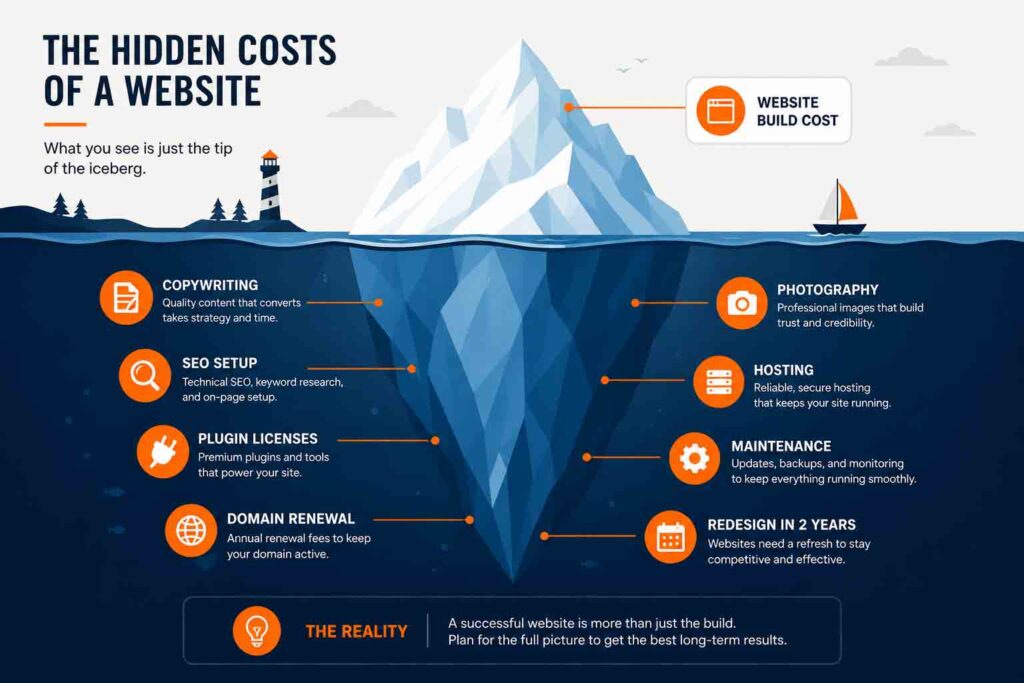
The Hidden Costs Most Agencies Won't Mention Upfront
This section is the one most agency blogs skip. We’re including it because you deserve to know what you’re walking into.
Google’s Core Web Vitals directly influence where your site ranks — and most cheap builds fail these benchmarks on launch day.
How Do AI Search Engines Decide Which Businesses to Cite?
1. Content creation
Most agency quotes assume you will hand over your copy, photos, and brand assets ready to go. In reality, almost no client does this. Professional copywriting for a 10-page business website runs $1,500–$5,000 in Canada. Custom photography adds another $500–$2,000. If your quote doesn’t include content, build this into your total budget before comparing proposals.
2. The rebuild you’ll need in 18 months
Websites built on proprietary platforms, cheap page builders, or with no attention to performance and SEO often require a partial or full rebuild within two years. A $2,000 website that becomes a $7,000 rebuild problem 18 months later is not the deal it seemed. Ask any agency you’re talking to: “What happens when I want to grow this site or switch providers?”
3. Lock-in traps
Some agencies — especially those offering very low monthly-subscription website packages — retain ownership of the domain, hosting account, and source code. If you leave, your site leaves with them. Before signing anything, confirm that you own your domain, your hosting account, and full access to the site files. This is non-negotiable.
4. SEO setup is rarely included in the build price
A website that no one can find on Google is a digital business card, not a business asset. Technical SEO setup — including proper URL structure, schema markup, page speed optimisation, and Google Search Console integration — is frequently an add-on. Ask specifically if it’s included, and what “SEO-ready” actually means in the proposal you’re reviewing.
5. Post-launch support
Websites need updates — security patches, plugin updates, broken-link fixes, and content changes. Many agencies include 30 days of post-launch support and then charge hourly after that. Hourly rates in Canada run $75–$175 for a competent developer. Get your support and maintenance plan in writing before you sign.
DIY Website Builders vs. Hiring a Professional: The Real Comparison
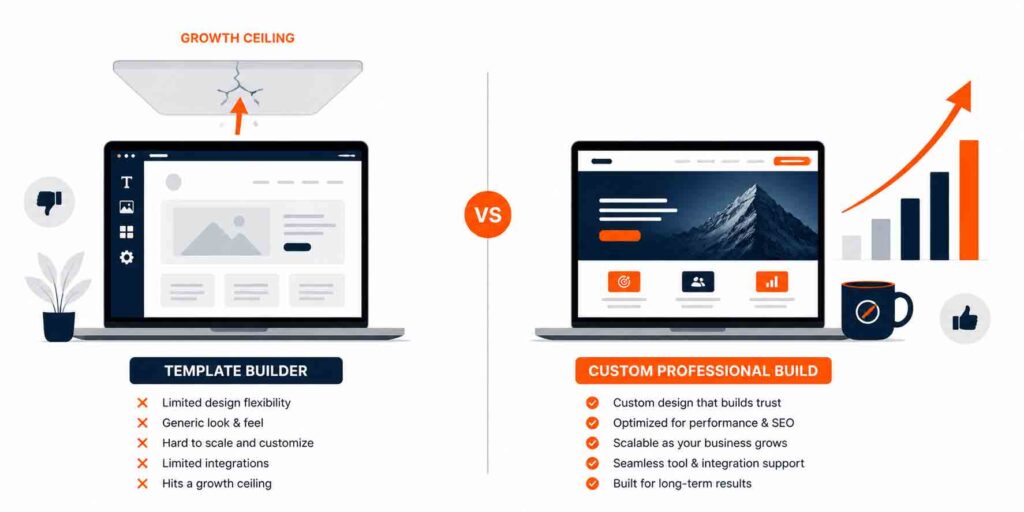
Squarespace, Wix, and Webflow have democratised web publishing. For personal projects, portfolios, and very early-stage businesses testing a concept, they make sense. But the conversation changes quickly once your website becomes a growth tool.
Here is what you give up with a DIY builder when you’re trying to grow a business in Canada:
- SEO ceiling: Template builders have real technical limitations that prevent pages from ranking for competitive keywords. Site speed, crawl structure, schema markup, and Core Web Vitals are all constrained by the platform.
- Conversion architecture: A professional site is built around a customer journey — a logical sequence that moves a visitor toward an action. Template sites are built around aesthetics. These are not the same thing.
- Scalability: When you need to add a booking system, a members-only section, a custom quoting tool, or a content hub, a template builder either can’t accommodate it or charges heavily for the integration.
- Ownership: Your Squarespace site lives on Squarespace’s servers, under their terms of service, with their export limitations. You do not own it the way you own a custom-built site.
Statistics Canada tracks this shift Canadian digital commerce has grown consistently year over year, and consumer expectations have followed
Our Rule of Thumb If your website is meant to generate leads, sell products, attract local search traffic, or represent a business you’re serious about scaling — hire a professional. The math works in your favour inside 12–18 months of launch.
7 Questions to Ask Before Hiring Any Web Agency in Canada
Proposals look very similar on paper. These seven questions will reveal more about what you’re actually buying than any brochure or portfolio page will.
- “Who owns the domain, hosting account, and source code after launch?” — The only acceptable answer is: you do. Completely.
- “What CMS will my site be built on, and can I update it myself?” — You should be able to edit content without calling a developer every time.
- “Is SEO setup included? What specifically does that mean in your proposal?” — Push for specifics: page titles, meta descriptions, schema, speed, redirect structure.
Third-party review platforms like Clutch let you verify an agency’s track record with real client reviews before you commit. - “What happens to my site in 3–5 years? Can you show me a site you built 4 years ago that’s still performing?” — Longevity is a real differentiator.
- “What does your post-launch support look like, and what does it cost?” — Get it in writing, not a verbal promise.
- “Can you walk me through how this site will generate leads or sales, not just look good?” — Strategy-first agencies will answer this confidently. Others will pivot back to design.
- “Who, specifically, will be working on my project?” — Understand whether it’s being built in-house or outsourced to contractors in another country without your knowledge.
What Does a Website Cost in Kitchener-Waterloo Specifically?
As a digital agency rooted in the Waterloo Region, we can speak to local pricing with more specificity than a national average can offer.
Kitchener-Waterloo has a unique market dynamic. It sits at the intersection of a major tech ecosystem (Velocity, Communitech, 1,400+ tech companies) and a dense small-business community in the trades, professional services, manufacturing, and retail sectors. That means web agencies here serve both sophisticated tech clients and traditional SMBs — and pricing reflects that range.
In the Waterloo Region, you can expect:
- Freelancers: $1,500–$6,000 for a basic build. Quality varies significantly. No long-term support typical.
- Boutique agencies (like Tecticx): $5,000–$20,000 for strategy-first, custom builds. Full ownership, local support, and growth-oriented architecture.
- Toronto-tier agencies working remotely: $15,000–$50,000+. Often excellent work, but overhead is baked into every proposal.
One advantage of working with a Waterloo Region agency is proximity and accountability. We know the local market — what works for a Kitchener trades company is different from what works for a Cambridge manufacturer or a Waterloo tech startup. That context matters, and it doesn’t cost extra.
Related reading on the Tecticx blog:
Stop Thinking About Cost — Start Thinking About Return
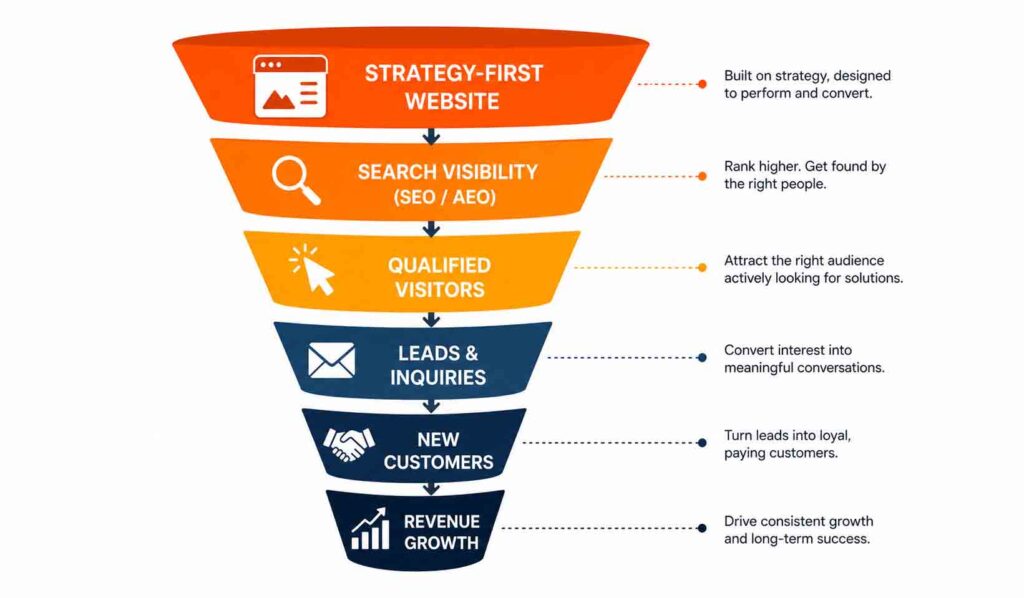
Here is the mindset shift that separates businesses that win online from those that stall: a website is not a cost. It is a sales asset with a measurable return on investment.
If a properly built $10,000 website generates five qualified leads per month at a client value of $3,000 each, it has paid for itself inside 30 days of launch. If a $1,500 website generates zero leads in its first year, it costs you far more than the $1,500 it costs you for the year.
The question to ask yourself is not “How cheap can I get this website?” The question is: “What would a single new customer be worth to my business and what would I pay for a system that delivers one every week?”
At Tecticx, we build websites as the foundation of a digital ecosystem, one where your site, your SEO, your content, and your AI search visibility all reinforce each other. We call it the 3T approach: the right techniques, the right technology, and a real digital transformation. It’s not just a website. It’s the infrastructure your business grows on.
Frequently Asked Questions About Website Costs in Canada
A basic professional website for a small Canadian business typically starts around $3,500–$5,000 for a strategy-focused agency build. Entry-level freelancer work starts lower (around $1,500), but often lacks the SEO structure and conversion design that makes a site valuable long-term. DIY platforms like Wix or Squarespace run $20–$50 per month plus setup time.
Custom-designed, strategy-first websites for established Canadian businesses typically cost between $8,000 and $25,000. Projects that include e-commerce, complex integrations, or large content libraries can exceed $40,000. The wide range reflects scope, not quality — always ask what’s actually included.
Yes, modestly. Toronto and Vancouver agencies carry higher overhead and typically charge 20–40% more than agencies in cities like Kitchener-Waterloo, Calgary, or Halifax for comparable work. The rise of remote work has narrowed this gap, but local agency pricing still reflects local operating costs.
Plan for $80–$300/month in ongoing costs for a professional Canadian business website. This covers managed hosting, SSL, security monitoring, backups, plugin updates, and basic maintenance. SEO and content services are additional.
A standard small business website from a professional Canadian agency takes 4–10 weeks from signed contract to launch. Larger or more complex builds take 3–6 months. Timeline is driven by scope, how quickly the client provides content and feedback, and agency capacity. from professional support.
Yes — if your needs are genuinely straightforward (5–8 pages, no ecommerce, no custom functionality, minimal SEO ambition). Be realistic about what you’re buying. A well-built $4,000 site from a focused boutique agency can outperform a $12,000 site from an agency that over-promises and under-delivers. Ask to see live examples and speak to their past clients.